From the archive
Qatar Emir Projects $1 Trillion US Trade, Welcomes US-Iran De-escalation
Qatar's Emir projects US trade to surpass $1 trillion and welcomes US-Iran de-escalation, seeing it as a step toward regional stability.
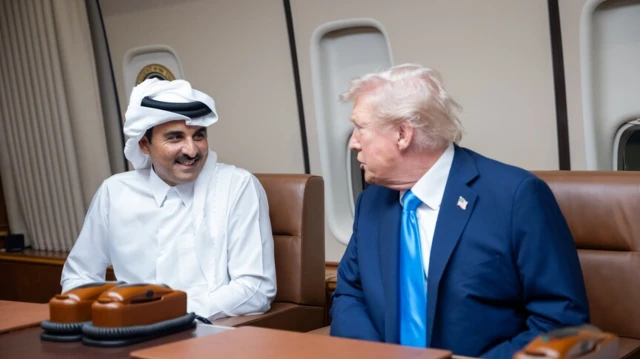
Qatar’s Emir Sheikh Tamim bin Hamad Al Thani announced that bilateral trade with the United States is projected to exceed $1 trillion, a statement made during a joint press appearance with US President Donald Trump. The announcement took place on the sidelines of the G7 leaders’ summit in France, a significant international forum that showed the global importance of the discussions. Sheikh Tamim bin Hamad Al Thani also characterized the recently brokered US-Iran agreement as a key step toward de-escalation in the Gulf and the wider Middle East, expressing optimism for its potential impact on regional stability.
Speaking alongside President Trump, Sheikh Tamim bin Hamad Al Thani emphasized the ongoing efforts required for regional stability. "There’s still a lot of work to be done, but with this momentum… we can achieve and do great things in the region," Qatar’s emir stated. He further affirmed Qatar's willingness to assist in diplomatic efforts, noting, "Whenever friends ask us to help," noting his country's role in facilitating dialogue. This commitment from Qatar positions it as a key player in fostering peace and understanding in a complex geopolitical landscape. The emir's comments on the sidelines of the G7 summit provided a clear indication of Qatar's strategic foreign policy, which prioritizes both economic partnership and regional mediation. His remarks show the intertwined nature of economic prosperity and political stability in the Gulf.
US-Iran Agreement Details
The US-Iran agreement, mediated by Pakistan, is slated for signing in Switzerland on Friday, with the official ceremony scheduled for June 19. This formal signing event is expected to draw significant international attention given the high stakes involved. Vice President JD Vance announced that international nuclear inspectors will return to Iran as part of the agreement, marking a key step towards renewed oversight of Iran's nuclear program. Under the terms, the International Atomic Energy Agency (IAEA) and the United States will assist Tehran in destroying its highly enriched uranium stockpile, a measure designed to alleviate concerns about nuclear proliferation. The destruction of this stockpile is a central component of the agreement, aiming to reduce Iran's potential for developing nuclear weapons. No sanctions relief has been provided yet, according to official statements, indicating that further steps and compliance will likely be required before economic penalties are eased. The absence of immediate sanctions relief suggests a cautious approach from the international community, linking future economic benefits to sustained adherence to the agreement's terms.
Several Iranian oil tankers and cargo vessels passed through the United States naval blockade in the Strait of Hormuz without obstruction on Tuesday. This marked the first such movement since Washington and Tehran agreed to end their war, signaling a tangible de-escalation of maritime tensions. The unimpeded passage of these vessels represents a significant confidence-building measure following the cessation of hostilities. Iranian Parliament Speaker Mohammad Bagher Qalibaf will head the delegation during the signing of a memorandum to end the war with the United States in Switzerland. His leadership of the delegation shows the importance Iran places on this agreement and its commitment to formalizing the end of the conflict. Vice President JD Vance will attend the Friday ceremony in Geneva, confirming high-level participation from the US side. The presence of such senior officials from both nations at the signing ceremony in Geneva notes the gravity and diplomatic significance of this breakthrough agreement, which aims to usher in a new era of reduced confrontation between the two countries.
Regional Diplomacy and Context
Türkiye remains closely engaged with all stakeholders concerning regional developments, actively pursuing diplomatic avenues to support stability. The Qatari emir reiterated Doha’s readiness to provide good offices and logistical support for ongoing diplomatic efforts, reinforcing Qatar's established role as a regional mediator. This offer of support from Qatar is consistent with its foreign policy of constructive engagement and facilitation of dialogue. President Recep Tayyip Erdogan welcomed the agreement reached between Washington and Tehran, characterizing it as an important development for regional stability. His endorsement adds significant weight to the agreement, given Türkiye's own strategic interests and influence in the broader Middle East. Erdogan's statement reflects a shared regional desire for de-escalation and peaceful resolution to long-standing conflicts, recognizing the potential positive ripple effects of the US-Iran accord.
Turkish Foreign Minister Hakan Fidan has been active in diplomatic engagements across Asia, demonstrating Türkiye's proactive foreign policy. Hakan Fidan held talks with Bangladeshi Prime Minister Tarique Rahman in Dhaka on Saturday, discussing bilateral relations and regional issues. Earlier in the week, Hakan Fidan was welcomed by his counterpart Sugiono in Jakarta on Wednesday, further extending Türkiye's diplomatic reach into Southeast Asia. These meetings show Türkiye's efforts to cultivate stronger ties and foster cooperation beyond its immediate neighborhood. Additionally, Türkiye's Foreign Minister Hakan Fidan met with Singaporean Prime Minister Lawrence Wong on June 2, indicating a broader engagement strategy in the Asia-Pacific region. This series of high-level diplomatic meetings notes Türkiye's commitment to building partnerships and promoting stability across various geographical fronts, reflecting a full approach to foreign policy.
In related diplomatic statements, Iranian Foreign Minister Abbas Araghchi said on Tuesday that an end to Israeli military operations in Lebanon constitutes a prerequisite for halting the war between Tehran and the US-Israeli alliance. This statement links the broader regional conflict to the specific issue of Israeli actions in Lebanon, outlining Iran's conditions for a complete cessation of hostilities. Meanwhile, US Special Presidential Envoy Tom Barrack and Iraqi Prime Minister Ali Al-Zaidi discussed Baghdad's efforts to consolidate all weapons under state authority and disband armed groups operating outside government control, noting ongoing security concerns in the region. The discussions between Barrack and Al-Zaidi show the challenges faced by Iraq in asserting its sovereignty and maintaining internal security, issues that are often exacerbated by regional tensions. These diplomatic exchanges reveal the complex web of interconnected issues that continue to shape the political and security landscape of the Middle East, even as steps towards de-escalation are being made.
Escalating Tensions and Israeli Actions
Iran's Supreme Leader Mojtaba Khamenei declared on Monday that Israel's "shaky Zionist regime" has only a limited time remaining. This statement followed a series of escalating military actions, reflecting the deep-seated animosity and ongoing conflict between the two nations. Tehran launched missiles at northern Israel, a direct military action that significantly heightened tensions. In response, Israeli warplanes strike multiple Iranian cities, including the capital, illustrating the retaliatory nature of the conflict. The military exchanges marked a significant escalation in regional tensions, demonstrating the volatile nature of the security situation and the potential for rapid deterioration. These direct military confrontations show the fragility of peace in the region and the urgent need for diplomatic solutions to prevent further escalation. The exchange of fire represents a dangerous cycle of aggression that has long plagued relations between Iran and Israel.
In a separate development, Israeli occupiers bulldozed the sole water pipeline serving Umm Safa village, northwest of Ramallah. The action cut off running water to residents in the area, exacerbating humanitarian concerns for the affected population. This act of infrastructure destruction has severe consequences for the daily lives of the villagers, raising alarm among human rights organizations. Additionally, Israel plans to allocate $1.89 million to fund the extremist Hilltop Youth group. This funding decision has drawn scrutiny amid ongoing regional instability, with critics arguing that it could further inflame tensions and contribute to violence in the West Bank. The allocation of funds to such a group is seen by many as a provocative move, potentially undermining efforts towards peace and stability. These actions highlight the multifaceted nature of the conflict, encompassing not only military confrontations but also issues of humanitarian access, settlement expansion, and the funding of controversial groups.
Qatar's Role and Future Outlook
Qatar’s ruling emir has projected the trade and investment relationship with Washington will exceed the $1 trillion mark. This significant projection shows the growing economic ties between the two nations, noting Qatar's ambition to deepen its partnership with the United States. The US-Qatar trade corridor is emerging as a cornerstone of Washington’s commercial engagement in the Arabian Gulf, solidifying Qatar's position as a key economic partner in the region. This development notes the strategic importance of Qatar in facilitating American trade and investment, further integrating the economies of both countries. The projected figure reflects an ambitious outlook for future collaborations, suggesting a strong and expanding economic relationship. This substantial increase in trade and investment is expected to generate mutual benefits, fostering economic growth and creating new opportunities for businesses in both countries. The emir's announcement, made during the high-profile G7 summit, served to amplify the message of Qatar's economic significance and its role as a stable and reliable partner for the United States.
The commitment to reaching over $1 trillion in bilateral trade and investment signifies a long-term strategic vision for the US-Qatar relationship. This economic partnership extends beyond mere commodity exchange, encompassing investments across various sectors, including technology, energy, and infrastructure. Qatar's sovereign wealth fund, the Qatar Investment Authority (QIA), has been a significant investor in the United States, channeling capital into diverse American industries. These investments not only provide financial returns but also strengthen the economic interdependence between the two nations. The projected growth in trade and investment is also indicative of Qatar's broader economic diversification strategy, which seeks to reduce its reliance on hydrocarbon revenues by fostering a more knowledge-based and diversified economy. By positioning itself as a key economic hub and a reliable partner, Qatar aims to enhance its geopolitical standing and ensure its long-term prosperity. The ongoing dialogue and collaboration between Qatari and US officials are expected to facilitate the necessary frameworks and agreements to achieve this ambitious $1 trillion target, further cementing the bond between Doha and Washington.