From the archive
Kerala Consumer Commission Slaps Rs 10 Lakh Fine on Qatar Airways for Denying Boarding to Children
Kerala commission fines Qatar Airways Rs 10 lakh for denying boarding to a family's children, including an infant, despite issuing passes.
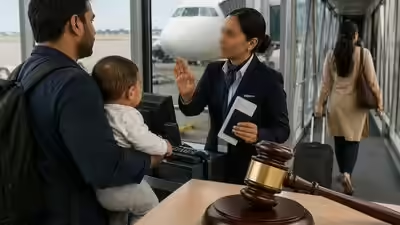
A consumer commission in Kerala has found Qatar Airways guilty of deficiency in service and unfair trade practice, imposing a fine of Rs 10 lakhs on the airline. The verdict by the Kerala State Consumer Disputes Redressal Commission in Ernakulam comes after the airline denied boarding to an infant and her family, despite having issued return tickets and boarding passes for the entire family. The commission's decision addresses the refusal of service that led to the family's inability to travel on their booked flight, noting the airline's shortcomings in customer care and adherence to travel protocols. The Kerala State Consumer Disputes Redressal Commission explicitly held Qatar Airways guilty of both deficiency in service and unfair trade practice, forming the basis for its significant penalty.
Family's Travel Ordeal
Roshan Jose, his wife Vinaya, and their two children traveled from Venice, Italy, to Kochi in November 2018 for a holiday. The airline had indeed issued return tickets and boarding passes for the entire family, including the infant, signifying their acceptance of the family's travel arrangements. On December 3, 2018, the family arrived at the check-in counter at Kochi International Airport for their return flight. Just ten minutes before the scheduled departure, Qatar Airways personnel refused a boarding pass to the elder son, who was six years old at the time. The airline stated that the child did not possess a separate visa for the journey. This refusal, coming at such a critical juncture, initiated a cascade of distress for the family.
Faced with the imminent departure and the airline's unexpected refusal, the family was compelled to make an agonizing decision. They handed over the elder child to relatives who were present at the airport, hoping to proceed with the rest of their journey. Vinaya then boarded the flight to Venice alone, under immense emotional strain. Concurrently, Roshan Jose and the infant were obliged to return to Kochi, unable to travel as planned. This separation and disruption of their travel plans showed the severity of the airline's actions.
The ordeal continued even for those who initially received boarding passes. The parents and the infant were initially given boarding passes for their journey from Kochi. However, the situation deteriorated further during their layover. At Doha, the airline refused to let the infant board the connecting flight to Venice, despite the infant possessing a valid boarding pass that had been issued in Kochi. This second refusal meant that Vinaya flew to Venice alone, while Jose returned to Kochi with the infant, further complicating an already distressing situation. The commission noted this inconsistency as a key factor in its judgment.
The Kerala State Consumer Disputes Redressal Commission noted the inconsistency of the airline's actions in its ruling. The commission stated, "Having allowed the infant to travel from Venice to India, the subsequent refusal of permit for the return journey from India on the very same set of documents is patently inconsistent, unjustified and highly reprehensible." This statement showed the commission's finding that the airline's decision to deny boarding was unwarranted, given the earlier approval of travel on the same documentation. The commission observed that the airline's conduct created an unacceptable situation, forcing the family to endure unnecessary hardship and separation.
Commission's Findings
Qatar Airways denied boarding to a family's two children, including a 10-month-old breastfeeding infant, during their return flight from Kochi to Italy. The complaint was filed by Roshan Jose, an Indian expatriate working in Italy, seeking redress for the considerable distress and financial losses incurred. The parents and the infant were initially given boarding passes for their journey from Kochi, which made the subsequent denial of boarding even more perplexing and arbitrary. However, upon arrival in Doha, the airline refused to let the infant board the connecting flight to Venice, despite the infant possessing a valid boarding pass that had been issued in Kochi. This refusal in Doha led to Roshan Jose and the infant being stranded and forced to return to Kochi, while Vinaya had to proceed to Venice alone.
The infant subsequently stayed in India with relatives for several weeks before eventually being brought back to Italy. This prolonged separation from her mother and the additional travel arrangements created significant emotional and logistical burdens for the family. The commission noted that Qatar Airways had previously accepted and verified the family's travel documents before their initial journey from Venice to Kochi without raising any objections. This prior acceptance made the subsequent refusal of boarding particularly problematic for the commission, indicating a clear inconsistency in the airline's application of its own rules or understanding of international travel requirements. The commission emphasized that the airline's initial verification of documents set a precedent that it then inexplicably failed to uphold during the return journey.
The commission concluded that the airline's decision to deny boarding to the children during the return journey was arbitrary. The lack of a consistent reason for the refusal, especially given the prior acceptance of the same documents, pointed to a deficiency in the airline's service. "Having allowed the infant to travel from Venice to India, the subsequent refusal of permit for the return journey from India on the very same set of documents is patently inconsistent, unjustified and highly reprehensible," the commission stated in its findings. It further noted the impact on the family, asserting, "The mental agony, emotional trauma and untold hardship suffered by the parents were the direct and inevitable consequence of the wrongful conduct of the opposite party." The commission's findings painted a clear picture of an airline failing in its duty of care towards its passengers, particularly vulnerable ones like an infant and a young child.
The Verdict and Penalties
The District Consumer Disputes Redressal Commission, Ernakulam, directed Qatar Airways to pay Rs 10 lakh as compensation for denying boarding. An order issued on July 14 also stipulated that the airline must pay an additional Rs 25,000 towards litigation costs, covering the expenses incurred by the complainant in pursuing justice. The commission further directed Qatar Airways to comply with the order within 45 days. This timeframe provides a clear deadline for the airline to fulfill its obligations. If the compensation amount is not paid within this period, it will accrue 9 percent annual interest from the date the complaint was filed until the amount is realized, ensuring that the airline faces further financial penalties for delayed compliance.
The bench, comprising President D.B. Binu and Members V. Ramachandran and Sreevidhia T.N. Delivered a strong condemnation of the airline's actions. They stated, "The conduct of the opposite party in preventing a child from accompanying his parents on the return journey is wholly arbitrary and has shocked the conscience of this commission." This statement reflects the profound impact of the airline's decision on the commission's perception of justice. The commission noted that the airline's actions were inconsistent, a recurring theme throughout its findings. It stated, "Having allowed the infant to travel from Venice to India, the subsequent refusal of permit for the return journey from India on the very same set of documents is patently inconsistent, unjustified and highly reprehensible." The commission also emphasized the severe impact on the family, asserting, "The mental agony, emotional trauma and untold hardship suffered by the parents were the direct and inevitable consequence of the wrongful conduct of the opposite party." This full verdict aims to compensate the family for their suffering and to deter similar arbitrary actions by airlines in the future.