From the archive
Qatar Opposes Permanent Hormuz Tolls, Open to Temporary Fees for Reopening
Qatar opposes permanent tolls for the Strait of Hormuz but would consider temporary fees for waterway reopening, according to its Deputy Prime Minister.
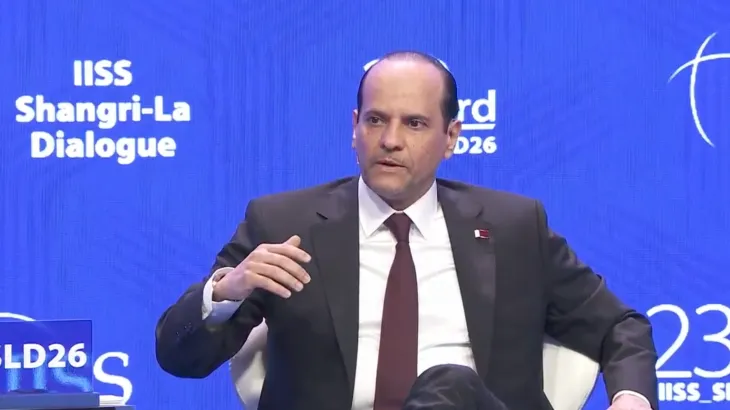
Qatar's Deputy Prime Minister, Sheikh Saoud bin Abdulrahman bin Hassan bin Ali Al Thani, stated the nation's steadfast opposition to permanent tolls for passage through the Strait of Hormuz. Speaking at the Shangri-La Dialogue, Sheikh Saoud indicated that Qatar remains open to considering temporary fees as a potential measure to facilitate the reopening of the vital waterway. His remarks show Qatar's principled stance on maritime transit in the critical region, balancing its own economic interests with broader geopolitical concerns regarding the free flow of shipping. The discussion comes amidst ongoing regional considerations for the Strait of Hormuz, a key conduit for global energy supplies, noting the complex interplay of security and commerce in one of the world's most strategic maritime passages.
Stance on Waterway Fees
Qatar maintains its firm opposition to the implementation of a permanent toll for vessels transiting the Strait of Hormuz. Sheikh Saoud bin Abdulrahman bin Hassan bin Ali Al Thani, Qatar's Deputy Prime Minister, articulated this position clearly during the Shangri-La Dialogue, emphasizing that such a permanent charge would be unacceptable. While rejecting permanent charges, Sheikh Saoud noted that Qatar would indeed consider temporary fees. These temporary charges, he explained, could serve as a practical and necessary mechanism to facilitate the reopening of the key waterway, particularly in scenarios where immediate action is required to restore safe passage. The Deputy Prime Minister's statements highlight Qatar's pragmatic perspective on maritime commerce and security in a strategically vital region for global energy shipments, reflecting a willingness to engage constructively on temporary solutions while upholding a core principle against permanent levies. The ongoing discussions surrounding potential fees reflect broader regional considerations regarding access and transit through the Strait of Hormuz, a waterway whose uninterrupted flow is critical to global economic stability.
Context of Strait of Hormuz
The Strait of Hormuz is a critical waterway connecting the Persian Gulf to the Arabian Sea and the open ocean, making it a key choke point for global oil and gas shipments. Situated strategically between Oman and Iran, its immense importance stems from the vast volume of maritime traffic it handles daily, including a significant portion of the world's liquefied natural gas (LNG) and crude oil exports. This narrow passage, which is approximately 21 miles wide at its narrowest point, serves as a vital artery for energy supplies originating from major producers like Qatar, Saudi Arabia, and the United Arab Emirates. Any disruption or change in transit conditions through the Strait can have immediate and broad implications for international energy markets and global trade, affecting prices and supply chains worldwide. Discussions surrounding transit fees or security measures in this area frequently draw intense international attention due to its unparalleled geopolitical and economic significance, showing the delicate balance required to maintain stability and free navigation. The continuous and unimpeded flow of maritime traffic through the Strait is therefore a matter of global concern.
Negotiable Terms for Passage
Qatar would consider a temporary fee negotiable if such a charge were specifically allocated to efforts aimed at reopening the waterway. Sheikh Saoud bin Abdulrahman bin Hassan bin Ali Al Thani, Qatar's Deputy Prime Minister, elaborated that this could include funding operations such as the removal of sea mines, which would directly contribute to restoring safe passage through the Strait of Hormuz. He showed that Qatar would find a temporary fee negotiable if its purpose was clearly defined and directly linked to ensuring the security and navigability of the strait. This conditional openness to temporary fees contrasts sharply with Qatar's firm opposition to any permanent toll, indicating a practical willingness to engage in discussions that prioritize the immediate restoration of maritime safety and transit. The Qatari stance emphasizes that any financial contribution would need to be directly tied to facilitating the waterway's operational readiness and security, rather than serving as a continuous revenue stream. This approach reflects a commitment to regional stability and the unimpeded flow of international commerce.