From the archive
Seminar Explores Evolution and Challenges of Social Thinking in the Gulf
A seminar at the Doha International Book Fair explored the evolution, paths, and challenges of social thinking in the Gulf region, stressing context.
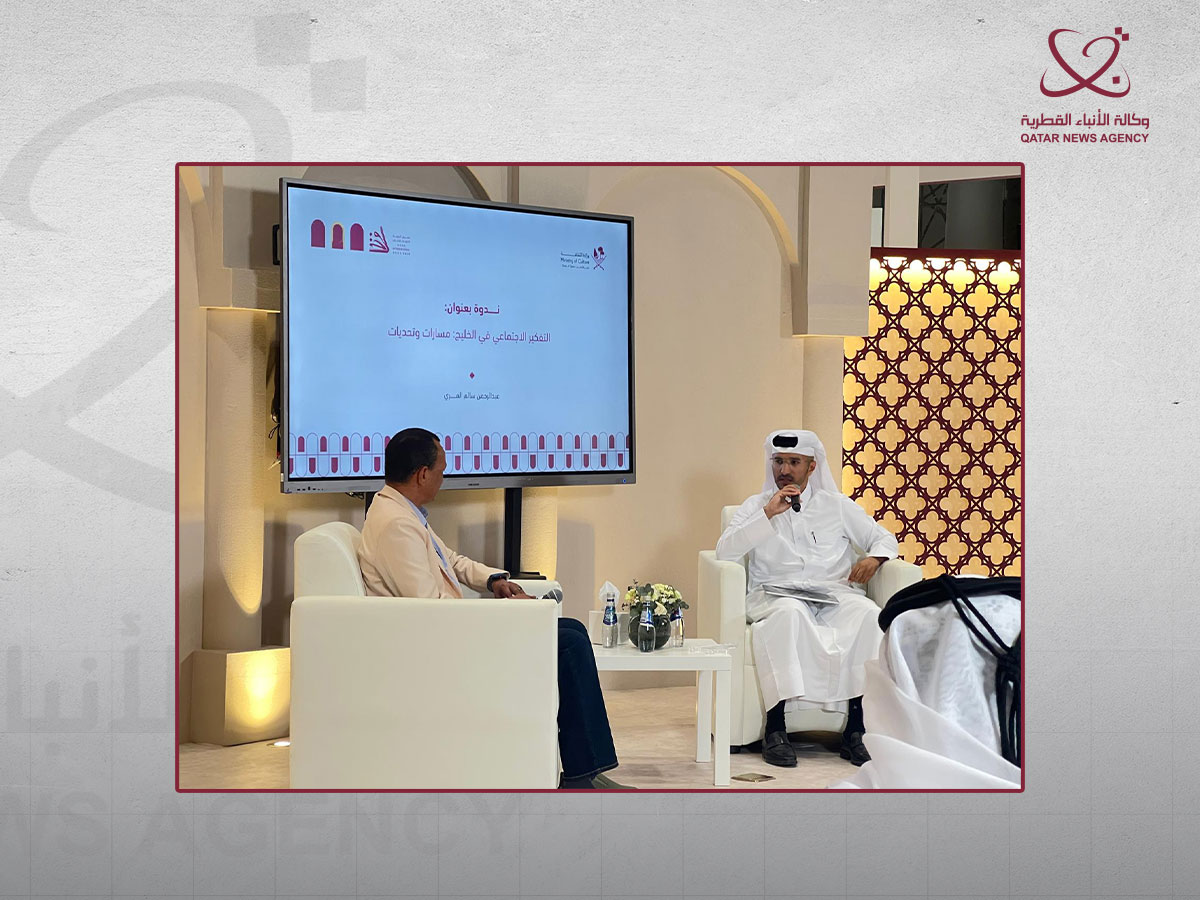
Social sciences researcher Abdulrahman Al-Marri presented a seminar titled "Social Thinking in the Gulf: Paths and Challenges" at the Cultural Salon of the 35th Doha International Book Fair on May 23, 2026. This significant event, part of the 35th edition of the Doha International Book Fair, was moderated by writer Mohammed Yousef Al-Arki. The seminar comprehensively discussed the development of social thinking in the Gulf region, focusing on its intellectual and methodological paths over past decades. During his presentation, Al-Marri articulated a foundational principle, stating, "The Gulf societies cannot be studied in isolation from their cultural and historical contexts and the mutual influence relationships between them and their surroundings." This statement showed the interconnectedness of Gulf societies with their broader environment, a theme that resonated throughout the discussion.
Historical Paths of Thought
The seminar delved into the historical evolution of social thought in the Gulf. Early social thinking in the Gulf region was intrinsically connected to journalistic writings, magazines, and periodicals that began appearing from the 1920s. These early publications served as key platforms for nascent social commentary and analysis. Following this initial phase, the period of establishing modern states and independence in Gulf countries prompted a new wave of writings. These works specifically addressed the formation of modern cities such as Doha, Kuwait, and Manama, reflecting on the rapid urban and societal transformations occurring at the time. Later, a distinct stream of specialized academic studies on social issues emerged, contributing significantly to the evolving intellectual landscape. This academic turn marked a shift towards more structured and systematic inquiry into societal phenomena. A third distinct stream of thought began from the 1980s, characterized by critical writings that focused intently on the concept of society and its ongoing transformations within the region. This evolution demonstrates a clear progression from early journalistic observations to more structured academic inquiry and critical analysis regarding social dynamics in the Gulf, showcasing the deepening engagement with societal issues over time.
Methodological and Theoretical Hurdles
The seminar extensively covered the methodological issues that accompanied the evolving paths of social thinking in the Gulf. These challenges often stemmed from a tendency to treat society as an abstract concept or theoretical metaphor, frequently detached from actual social reality. This approach sometimes resulted in analyses that did not fully engage with the lived experiences and concrete dynamics of Gulf societies, leading to a gap between theoretical constructs and empirical observations. The challenges extended deeply to theoretical frameworks, particularly in understanding local society and its complex relationship with the broader regional environment. Researchers frequently grappled with developing theoretical models that adequately captured the unique social structures and historical trajectories of the Gulf states while also acknowledging their interconnectedness with regional and global contexts. This required a careful balance to avoid generalizations that might obscure local specificities or overemphasize external influences without strong empirical grounding. The seminar noted that these methodological and theoretical hurdles continue to shape the discourse on social thinking in the region, prompting ongoing discussions about more appropriate and nuanced approaches that better reflect the complex realities of Gulf societies.
Practical and Institutional Obstacles
Challenges facing social thinking in the Gulf were comprehensively categorized into theoretical, practical, and institutional obstacles during the seminar. The theoretical challenges, as previously discussed, are intricately linked to understanding local society and its relationship with the broader regional environment, requiring nuanced approaches. Practical and institutional challenges were identified as specific areas requiring significant development to advance social thought in the region. These include, crucially, the establishment of specialized scientific groups dedicated to social research. Such groups would foster collaborative environments and concentrated efforts on specific social phenomena.
Further institutional support is considered essential for progress, encompassing increased funding for social science programs. This financial backing is vital for facilitating in-depth research, supporting researchers, and developing new methodologies. The seminar emphasized the critical need to set clear academic visions. These visions would define research priorities and guide postgraduate study topics, aiming to strengthen the foundational structures supporting social thinking in the Gulf. By addressing these practical and institutional barriers, the region can cultivate a more strong and impactful social science landscape.
Contextualizing Gulf Societies
Social sciences researcher Abdulrahman Al-Marri previously emphasized that Gulf societies cannot be studied in isolation. Their cultural and historical contexts, alongside mutual influences with their surroundings, are key for full understanding. The seminar reinforced this perspective, showing that a holistic approach is necessary for accurate social analysis. The development of social thinking in the Gulf region has historically addressed the formation of modern cities like Doha, Kuwait, and Manama, reflecting the significant societal shifts brought about by modernization and state-building. Academic studies on social issues and critical writings examining societal transformations have also emerged, demonstrating a continuous intellectual engagement with the region's evolving dynamics. This intellectual evolution notes the continuous effort to contextualize local societies within their broader regional and global environments, aiming to capture unique social structures and the intricate web of relationships that define them. The ongoing dialogue, as evidenced by the seminar, seeks to bridge theoretical frameworks with empirical realities, ensuring that social thinking in the Gulf remains relevant, insightful, and reflective of its complex and dynamic societies.