From the archive
US Legal Group Urges Probe into Georgetown's Ties with Qatar
A US legal group urges the Justice Department to probe Georgetown University for allegedly acting as a foreign agent of Qatar, citing a contract that…
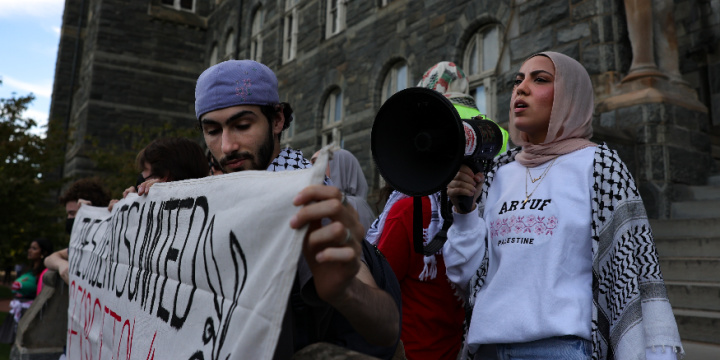
The Louis D. Brandeis Center for Human Rights Under Law has urged the federal government to investigate whether Georgetown University violated the law by not registering as a foreign agent, asserting that the issue regarding the institution's ties with Qatar remains unresolved. The Louis D. Brandeis Center for Human Rights Under Law insisted that the matter is not over and called on the federal government to determine whether Georgetown University broke the law by failing to register itself as a foreign agent. According to the center, the partnership between Georgetown University and Qatar led to the university inviting individuals described as Islamists with connections to the Qatari government. These invitees reportedly included extreme anti-Zionists and an unindicted co-conspirator from the 1993 World Trade Center bombing. The Brandeis Center's concerns highlight a broader scrutiny of foreign influence in American academia and the potential legal ramifications for institutions that fail to disclose such relationships.
The Contractual Arrangement
Georgetown University signed a $630,000 agreement with Qatar in 2024 to promote awareness of 'Islamophobia', as reported by The Washington Free Beacon. The final payment for this deal was disbursed in January. The specific terms of the agreement outlined the university's role in advancing public understanding of the issue, a role that the Brandeis Center argues crosses the line into foreign agency. The contract itself has become a focal point of the investigation demands, with its provisions drawing particular attention from legal advocacy groups. The agreement's financial details and the nature of the services rendered are central to the allegations of non-compliance with federal statutes.
Broader Qatari Influence
The Brandeis Center's letter to Acting US Attorney General Todd Blanche came less than four months after the Middle East Forum released a report describing how Qatar has allegedly exploited and manipulated Georgetown University since 2005. This report detailed a long-standing pattern of engagement that, according to the Middle East Forum, warrants a full review by federal authorities. Qatar is the single largest foreign source of funding to American colleges and universities, a position that grants it significant leverage and influence within the academic landscape. The sheer volume of these financial contributions has raised questions about the extent and nature of foreign government involvement in US educational institutions.
The federal dashboard indicates Qatar has provided $6.6 billion in gifts and contracts to US universities, showing the depth of its financial penetration into American higher education. This substantial investment is not evenly distributed, with several prominent institutions receiving the lion's share. Cornell University topped the list of recipients with $2.3 billion in Qatari funding, demonstrating a particularly strong financial link to the Gulf nation. Carnegie Mellon University received $1 billion from Qatar, while Texas A&M University obtained $992.8 million. Georgetown University itself received $971.1 million from Qatari sources, placing it among the top beneficiaries of Qatari largesse. These figures highlight a strategic approach by Qatar to establish and maintain relationships with leading American academic institutions through significant financial contributions.
Beyond academic institutions, Qatar has spent considerable sums on various sectors in the United States, illustrating a multi-faceted approach to influence and investment. Since 2012, the nation has allocated $33.4 billion to business and real estate projects, diversifying its economic footprint in the US. In addition, Qatar spent over $6 billion on universities and $72 million on American lobbyists during the same period. These expenditures collectively paint a picture of a nation actively seeking to expand its presence and influence across various spheres within the United States, from economic development to political advocacy and academic engagement.
A November 2025 report by the Institute for the Study of Global Antisemitism and Policy (ISGAP) found that Qatar funneled roughly $20 billion into American schools and universities over the past five decades. This long-term financial commitment, according to ISGAP, is part of a broader strategy. ISGAP argued that this financial influx facilitates a conspiracy to embed groups linked to the Muslim Brotherhood in American academia, civil society, and government agencies. This claim suggests a more insidious motive behind the funding, extending beyond mere academic partnership to potential ideological penetration. The report's findings have added another layer of complexity to the ongoing debate about foreign funding in higher education, prompting calls for greater transparency and oversight.
Reactions and Legal Arguments
The Louis D. Brandeis Center for Human Rights Under Law asserted that Georgetown University's arrangement with Qatar "clearly violates the Foreign Agents Registration Act" (FARA). The organization noted that the terms of the deal required the university to surrender intellectual and logistical control of events to the Qatari foreign ministry. Under the agreement, the Qatari foreign ministry reportedly held the right to dictate 'themes and speakers' for these events, a provision that the Brandeis Center argues constitutes acting as an agent of a foreign principal. FARA requires individuals and entities acting as agents of foreign principals in a political or quasi-political capacity to register with the Department of Justice, ensuring transparency regarding foreign influence. The center's legal argument hinges on the degree of control exercised by the Qatari government over Georgetown's activities, suggesting that the university's actions fall squarely within the scope of FARA's requirements.
The United States designated Qatar a major non-NATO ally in 2022, signifying a closer strategic relationship between the two nations. This designation reflects broader geopolitical considerations and strengthens the official ties between Washington and Doha. In December, then-President Donald Trump established a security commitment to defend Qatar if it faced attack by an aggressor, issuing an executive order to formalize this pledge. These diplomatic and security arrangements, while distinct from academic funding, provide a backdrop to the discussions about Qatari influence, illustrating the multifaceted nature of the US-Qatar relationship.
Further scrutiny of Qatari funding in academia has emerged through legal action. A recent lawsuit against Carnegie Mellon University alleges that a Diversity, Equity, and Inclusion (DEI) official at the institution obstructed an investigation into antisemitic discrimination. The lawsuit claims that this official's salary is partly funded by Qatar, raising questions about potential conflicts of interest and external influence on internal university processes. This specific case notes how foreign funding could potentially impact sensitive internal university matters and academic freedom, fueling concerns among advocacy groups and policymakers alike. The ongoing legal proceedings show the growing demand for accountability and transparency regarding foreign financial contributions to American universities. The outcome of such cases could set precedents for how universities manage foreign funding and address allegations of undue influence.